19th and 22nd Streets (Trolleys)
Trolley stations tend to be samey, so I’m combining these two into one post. This is the part of SEPTA where the El runs express in the center two tracks and the trolleys make these two local stops on the outer tracks, leading anyone passing through to think either, “Wow, thank goodness I’m on the El!” or “Man, I wish I was on the El.” As for anyone boarding at these stops? How about, “Geez, this station is terrible!”

An entrance to 22nd Street. Don’t trip on that stupid curb at the top!

One of the “fancy” entrances at 19th Street.
Each station has four entrances, one on each corner of their respective intersection. Of the eight total entrances, six are just generic stairs going down into the ground. However, the two southern entrances at 19th Street are different: one is made of metal and glass, and the other is made of stone. But…they’re still just generic stairs going down into the ground when you get right down to it.

The makeshift mezzanine at 22nd Street.
On October 1st, 2018, the westbound platforms at these stations got the new addition of turnstiles and fare machines. I came a little before that, so the turnstiles hadn’t been opened yet, but the setup was there: a few fare gates and one fare machine at each station. This is a great addition to these stops, especially because evening rush ridership here tends to be moderately high in the westbound direction. I can’t imagine how annoyingly long it would take for all those people to pay on board like they used to!

The cramped westbound platform at 22nd Street.

Those columns and stairs really cramp 19th Street’s style! Ha!
Despite generally getting more ridership than the eastbound direction, these westbound platforms are narrow! They both have few amenities other than a few benches and wastebaskets, and people tend to stand, anyway. The overall platform at 22nd is narrower than 19th, but 19th has a bunch of columns in the way (and I don’t think they serve much of a purpose, since 22nd gets away with not having them), plus these stairs and a ramp are needed to traverse the miniscule gap in height between the mezzanine and the platform. It shouldn’t have been built that way to begin with.

The eastbound platform at 22nd Street. Only one person here, and I don’t think they’re waiting for a train.
The eastbound platforms don’t tend to get quite as many people as the outbound ones, but still enough that I think it would be worth putting them into fare control as well. The one at 19th Street is similar to the westbound side, but at 22nd Street, the eastbound platform is huge! Finally, as I mentioned at the beginning, the El runs on the express tracks through these stations. It’s cool when they zoom by, but have fun not being able to hear for the next couple of weeks. Those trains, uh, get pretty loud…

My attempt to get both an El train and a trolley in the same picture at 22nd.

People boarding a 34 at 19th.
Stations: 19th and 22nd Streets (Trolleys)
Ridership: As usual, SEPTA treats these stations like glorified bus stops, so there’s no public ridership info on them. From what I’ve noticed, they never tend to get too crowded, although I’ve seen some decent amounts of people during the evening rush.
Pros: I absolutely love this arrangement where the El expresses through while the trolleys make local stops. The nonstop ride from 15th to 30th on El trains is fast and exhilarating, while the trolley stops are spaced out enough that they don’t feel too annoying (unlike some awful parts of the eastern El – 15th to 13th to 11th? Really???). Also, this may feel minor, but the signage at these stations is actually really good! They point out which exits are best to get to certain attractions and direct people to look for similar signs at street level.
Cons: Fare gates on the westbound side is a great start, but can we finish the job and put them on the eastbound side too? For trolleys at the front of a bunch, there can be enough people waiting to get to City Hall that it’s a significant delay for everyone to tap on at the front. Other than that, these stations just feel cramped, like they’re not using their space very well. Granted, there’s not too much space to begin with, but I’m sure the narrow platforms can be unpleasant to wait at during rush hour.
Nearby and Noteworthy: A ton. 19th Street is close to Rittenhouse Square and its ritzy businesses, some of the museums on Ben Franklin Parkway, and the Comcast Center (go see their free Holiday Spectacular – it’s a ton of fun). 22nd Street, meanwhile, is the closest stop to the Mütter Museum (which I really need to visit someday), some other museums up on Ben Franklin Parkway, and the most crowded Trader Joe’s I’ve ever been to.
Final Verdict: 4/10
I essentially said in my 37th Street review that the base trolley station is a 3. That station made it up to a 4 by having a unique entrance shaped like a streetcar. For these stations, the only thing raising them up to a 4 is the fact that they have fare control. And even then, it’s only on one side! Heck, if I gave half-points, this would probably only be a 3.5! My only hope is that the significant dwell time improvements here will lead SEPTA to install fare gates at the West Philadelphia trolley stations, too. Please.
Latest SEPTA News: Service Updates
SRTA: NB 4 (Ashley Boulevard)
A few years ago, I would’ve vehemently insisted on taking the NB 4 to its weekday rush hour-only terminus at “Industrial Park”, a full four miles past the regular terminus. Alas, Sam and I did our SRTA trip on a Saturday, so we couldn’t do an Industrial Park ride. We couldn’t even get one of the every-three-hour deviation to “Taber Mills Apartments”! Old Miles would kill me.

Hey, it’s a not-terrible photo inside the New Bedford Terminal! You won’t see many of these.
We began our trip by heading straight onto Pleasant Street, taking us straight out of downtown New Bedford almost immediately. It became Purchase Street pretty quickly, and though the neighborhood was mostly dense houses, we were very close to the Route 18 highway, which gave some sections of the road an industrial vibe. Once we went under I-195, the highway curved away and some train tracks were our new friends. Hey, they were on a nicely-landscaped embankment, so they felt a lot less intrusive.

This isn’t the nice part…
We headed down Sawyer Street for a short time before turning onto Ashley Boulevard (oh look, the name of the route!). This somewhat narrow street was lined with dense apartments, a contrast to the commercial Acushnet Ave a block away, which also gets a bus route. Acushnet Ave did eventually curve away, though, and Ashley Boulevard got a bit more retail to fill the gap.

Apartments, apartments, and more apartments.
We ran alongside the expansive Brooklawn Park, and right when we got to it, those apartments became suburban houses. Ashley Boulevard became a commercial street after the park, in the form of awful suburban businesses with parking lots. We passed a cemetery and New Bedford’s giant vocational technical high school, then we turned onto tiny Chaffee Street. This was just the bus’s loop to turn around – the other streets we used were Church Street, Staron Street, and Phillips Road, which led us to our final stop at my favorite supermarket, Trucchi’s.

Nice place to end.
SRTA Route: NB 4 (Ashley Boulevard)
Ridership: This is one of the busier New Bedford routes – it got 14,723 riders in May 2014, or about 545 passengers per day.
Pros: The base route is nice and direct, running as straight as it possibly could given New Bedford’s street network. It runs every half hour on weekdays, a great frequency (plus service runs ’till 9!).
Cons: Every 45 minutes on Saturdays is a little awkward, especially when most other routes come every 40 instead. Also, the Taber Mill Apartments deviation requires going down tiny one-way streets, and when buses only do it every two to three hours, what’s the point? It’s a three-minute walk from the main road! The rush hour industrial park variation is more useful, assuming it gets ridership.
Nearby and Noteworthy: The 4 is mostly residential, so there’s not much. I guess if you’ve just missed a 2, you can use it to get to Acushnet Ave a block away!
Final Verdict: 6/10
It’s fine. Nothing special. The route’s directness is great, especially compared to some other ones we’ll be seeing later. The Taber Mill Apartments deviation feels like a waste, though. Rather than awkwardly run a bus there every few hours, just make people walk three minutes! It’ll make the route much simpler, and probably more reliable, since the apartment trips get the same running time as normal ones when they obviously take longer.
Latest MBTA News: Service Updates
Snyder (BSL)
Of the South Philly Broad Street Line stops, Snyder is the one I’ve used the most so far. I’ve ridden both the 37 and the 79 a number of times (the latter’s review is in the pipeline, but I’m waiting for it to get the electric buses it’s supposedly going to get), plus the station is near the start of East Passyunk Ave – if I’m looking for somewhere to eat in that neighborhood, I can start here and work my way up. But here’s the big question: is Snyder actually a good station? Ehhhhhh…

A bus stop and a station entrance! Wow!
Snyder has connections to three bus routes: the 4, running down Broad Street (plus the Broad Street Owl at night); the 79, running down Snyder Ave; and the 37, which goes down Passyunk Ave on its way to the airport and Chester. Every single one of these stops has just a sign, except for one shelter at…the northbound 4 stop? Okay, not sure why that’s the one that gets a shelter when the 37 and 79 get exponentially more ridership from here. There’s not a lot of room for shelters on Snyder, but south Broad definitely has space for one at the 37 stop.

The one bus shelter and its corresponding entrance.
Snyder has one entrance on each side of the intersection, for a total of four. They all lead to the same mezzanine, and they’re all really simple staircases down from the street. There is also one exit-only escalator that gets a much more prominent sheltered structure over it. A flowerpot was put on top of it to try to make it look more appealing, but…no, it’s really not.

The exit-only escalator.
Each of the entrances leads to a claustrophobic passageway that takes you to the mezzanine. Some are longer than others, but none of them are particularly pleasant to walk through. The station also makes a big deal about the fact that you can bring your bikes down to the bike racks in the mezzanine (although according to the SEPTA website, those racks don’t exist), pointing out that two of the staircases feature ramps that you can roll your bike wheels down. They even have these lovely green paths pointing the way, but the problem is…neither of those staircases have ramps. I don’t know if they were vandalized or what, but if you’re gonna park your bikes here, you’re gonna be lugging them down the stairs yourself.

Jeez, this looks like a bomb shelter.
Oh, this is a SEPTA mezzanine if I ever saw one. It’s pretty big, but it’s full of fences and exit-only turnstiles, and it really doesn’t have much in it. All four entrances lead to only a few faregates, although the station does have three fare machines, which is plenty. Also, have fun using the faregate to nowhere…

Yeah, “USE NEXT WINDOW” is right.
Past the faregates is the waiting area, which is in view of the cashier, who has “direct contact with police.” So no funny business here! Seriously, though, it’s nice that there’s an area where people can feel safe while waiting for the train – this is common for SEPTA stations. It has plenty of seating space, plus wastebaskets, maps, and a lit-up sign that points out when a train is arriving and in which direction it’s going.

The waiting area. That signage is actually great!
The actual platform is as underwhelming as I would expect any Broad Street Line platform to be. Staircases lead down to it from the waiting room, and you end up on an island platform with some benches and wastebaskets sprinkled about. There are big industrial fans on each end to keep air circulating.

Down on the platform.
This thing is not trying to look pretty. Exposed random pipes and wires twist around every which way, while the tracks are covered in the characteristic SEPTA grime and trash. The platform itself is clean enough, but everything else combined with the lack of real-time information just makes this an unpleasant place to wait. Also, because of a provision built for an extension down Passyunk Ave, southbound trains have to enter Snyder really slowly. Considering the extension will never ever happen, it’s a little annoying.

Yup, nothing to see here.
Station: Snyder (BSL)
Ridership: Snyder is the busiest station in South Philly, with 5,953 riders per weekday. I’m not entirely sure why that is, but the station is in a really dense neighborhood with a ton of retail, plus two hospitals and the South Philadelphia High School.
Pros: Yeah, Snyder is in a great location. This is a retail hub of South Philadelphia, and even though there aren’t many, the bus connections here are important and well-used. As for the station itself? Uhhh…an entrance on each side of the intersection is nice…
Cons: The whole station feels cramped and ugly. As usual, there aren’t enough faregates for the ridership it gets, and the bus facilities have a similar problem when it comes to shelter and seating space. Also, you wanna know a glaring issue with Snyder that I haven’t touched on thus far? It’s not wheelchair accessible. Yes, most of the Broad Street Line stations in South Philly aren’t, but that’s still no excuse.
Nearby and Noteworthy: I mentioned the Melrose Diner in my last review, and I talked about the East Passyunk neighborhood in my post on the 45. Also, though I haven’t explored the area yet, there seem to be some funky hidden restaurants a few blocks northwest of this station, including a few breweries, if you’re into that kind of thing (ol’ Miles is underage, of course).
Final Verdict: 4/10
No accessibility, not enough faregates, not even mere benches for the busiest bus stops, and a general feeling of crumbling decrepitness: that’s Snyder. The south Broad Street Line needs an overhaul like what the El got a few decades ago, especially because of the lack of accessibility. There is a ton to do around this station, but if you’re in a wheelchair, tough luck. You’ll have to take (and suffer on) the 4 instead.
Latest SEPTA News: Service Updates
SRTA: NB 10 (Dartmouth Mall)
Yeah…Miles the “Transit Expert” screwed this one up. Guess who was looking at the weekday schedule instead of the Saturday schedule! Guess which route leaves fifteen minutes earlier on Saturdays! What did this little mistake mean? Basically skipping the NB 10‘s entire independent section…

Well…darn it.
The 10 basically operates in a giant loop, serving Dartmouth Mall twice. Because I missed the one going around the loop, I had to wait for the bus to come back and just go straight to the New Bedford Terminal. Let’s talk about the loop, though, because it’s basically the only thing this route has going for it.
After serving the Dartmouth Mall, buses head up to a deviation into Ann and Hope Plaza, previously seen on my NB 9 ride (I wasn’t a fan). The route goes up Faunce Corner Road from there, passing a lot of suburban businesses and going under I-195. A Vanity Fair outlet store, of all things, gets a deviation, as well as the Hawthorn Medical Association. That’s basically where the development ends and Faunce Corner Road turns to farmland, so buses turn around and retrace their steps for a while.
Right after passing I-195 again, the route goes down the residential Cross Road, specifically to serve (but not deviate into) the Cross Road Apartments. It’s all houses until a Walmart, at which point the route turns onto Frontage Road to better serve the giant outlet stores along State Road. This takes it back to the Dartmouth Mall, and that’s when I got on.

Next to a golf course.
The rest of the route is all parallel to the NB 9. We went by the New Bedford Country Club, a cemetery, and some residential neighborhoods, but suburban businesses permeated throughout. We didn’t enter a real urban environment until the road split into two one-way segments, where the houses got a lot more dense and the businesses were corner stores and restaurants integrated into the neighborhood. Finally, we merged onto North 6th Street and came down to the New Bedford Terminal.

Houses along a side street.
SRTA Route: NB 10 (Dartmouth Mall)
Ridership: About 266 people per day. My trip got ten people, and many of them got on at the mall, but I wish I could tell you what the ridership around the loop is like! Shoot.
Pros: The route runs every hour, Monday through Saturday, which I think is all it needs. The idea of a Dartmouth loop is decent, since there’s a ton of development along Faunce Corner Road. I also like how on Saturdays, the 10 coordinates with the 9 to provide half-hourly service to the Dartmouth Mall; on weekdays when the 9 is every half hour, the 10 just gets slotted fifteen minutes after a 9 trip every hour. That’s not quite as good, but it’s the best that can be done when the two routes run at different headways.
Cons: That loop business is pretty crazy – Ann and Hope Plaza is a dying strip mall, and I really don’t see much worth in deviating buses to a random clothing store (Vanity Fair), especially when it’s so close to the road. Aside from streamlining the loop, I also wonder if the route could be optimized better on weekdays, since it and the 9 run with different schedules.
Nearby and Noteworthy: Uhhhh…bargain clothes, anyone?
Final Verdict: 6/10
Okay, hear me out: make it a Dartmouth circulator on weekdays. Run it just around the loop every half hour, with coordinated connections to the 9. It could still go to New Bedford on Saturdays since the coordination is great, but I don’t think running it there on weekdays is as valuable. The problem is that with typical midday traffic conditions, the loop is awfully close to 30 minutes driving, and that’s with some of the lesser deviations cut out. That could affect the 10’s reliability. Well, as it stands, the route basically does the bare minimum as a loopy circulator route, and it’s fine. If only the loop was just a little bit faster, since I think running it as a circulator makes more sense.
Latest MBTA News: Service Updates
37 (Chester Transportation Center to Broad-Snyder)
I had just committed to Penn. My family flew down to Philly to spend a few days getting more acclimated to the city. We landed at the airport, where every sign told us to take the $6.75 Regional Rail line into town. But my family is cheap; why spend a ton of money on a train when we could take a bus for $2.50 instead? We only did part of the 37 that day, but now, it’s time to do the whole thing. The journey begins in Chester…

The bus laying over at Chester Transportation Center.
Going towards Chester, the bus appears to do a small loop north of the Regional Rail tracks, for some reason. According to Google Maps, this does not happen. Beats me. Going away from Chester, though, we just headed straight onto the route, like you would expect a normal bus route to do. We began on Avenue of the States, which was lined with buildings – some contained businesses, some were vacant.

A side street downtown.
Avenue of the States ended at Chester’s modern city hall, at which point we used 4th Street and Welsh Street to get onto a road known only as Route 291. It ended up becoming 4th Street a few blocks later, anyway. We had definitely left downtown Chester at this point, as the wide road breezed past industrial lots and vacant land. Outside of a prison, we used Morton Ave to deviate to Harrah’s. The bus stop was next to the casino’s parking garage.

A level crossing before the casino.
We came back to East 4th Street, which became increasingly highway-like as we came alongside the Northeast Corridor tracks. We entered Eddystone upon crossing Ridley Creek, where the road got the fitting name of Industrial Highway. Indeed, after going by Eddystone Station (one of the least-used on Regional Rail), there was a ton of industrial development, including two power stations!

One of the factories.
After crossing Crum Creek, the factories turned into office parks, specifically a giant Boeing complex. We went over another creek, Darby Creek, into Tinicum Township. There were a few “airport” developments like hotels and parking lots, and the wide highway became Governor Printz Boulevard. The road split into two one-way segments, and though the scenery was still really industrial, a few unfortunate houses and apartments were squeezed in between the auto shops and warehouses. The side streets were generally more residential.

You enter a much nicer neighborhood if you go far enough down this side street!
We soon entered a marshy industrial wasteland. All weekday trips turn onto Stevens Drive to deviate into the “Airport Business Center,” which is basically just three office buildings. We were truly in airport-land after we crossed some freight tracks, with a ton of parking lots and highway ramps everywhere. At the intersection with Bartram Ave, the long deviation to the airport terminals began. On weekdays, buses do an additional deviation-within-a-deviation to International Plaza, an office park.

Airport scenery.
We made our way onto the main arrivals road (also known as…Arrivals Road). Nearly this whole segment was spent underneath parking garages serving the various terminals. Terminal A had its smorgasbord of international airlines (plus American), Terminals B and C were all American, Terminals D and E had the airport’s non-American domestic offerings, and Terminal F was American Eagle, a subsidiary of…American. If it isn’t obvious, American offers a lot of flights out of Philadelphia.

Talk about a toll booth! This is to get out of the airport parking garages.
Leaving the terminals, we passed the giant Economy Parking lot and made a hairpin turn onto Airport Recirculation Road. It led us past all the car rental places before dumping us off at the intersection with Bartram Ave where we had initially started. We turned onto that, and it was basically a highway running through marshy, disgusting woods.

Who is this practically inaccessible shelter for? I have no idea.
A bunch of airport hotels showed up, and at this point, we turned onto 89th Street. This was a deviation to serve PNC Operations, a PNC Bank office. I’m not sure why this place gets deviations on weekends; on the Sunday I rode, no one got on or off here. After that, we headed up Tinicum Boulevard before going back onto Bartram Ave. Passing Eastwick Station on the Airport Line, we turned onto 84th Street, which crossed over the Regional Rail tracks.

The barren Eastwick Station.
We stayed on 84th until Lindbergh Boulevard, and we were now in a very odd part of Southwest Philadelphia. Both 84th and Lindbergh were giant roads, with express lanes in the middle and local lanes on the outside, separated by a grassy median. We actually travelled in the express lanes, since the local ones are really just meant for people parking at the austere row houses that line the road. This means that each bus stop is essentially on the median, requiring people to cross a small street to access.

The typical housing stock.
At Island Ave, we came across some suburban businesses and…a trolley? Yeah, the 36 trolley runs down here, and it looks really out of place amongst the sprawl! Continuing onward, Lindbergh Boulevard had more row houses to the west, but the east side was now industrial. The road made an s-curve further into the residential neighborhood, and so for a little while it was all apartments.

Yup, this came out of nowhere.
We turned onto 61st Street, heading back east into the wasteland of industry again. In this case, it was specifically a ton of auto scrap yards. It ended at Passyunk Ave, onto which we turned, crossing a bridge over the Schuylkill River. The other side was basically just a sprawling desert of the most unimaginably ugly industry you’ve ever seen.

For anyone coming from the airport, Philly is nice! I swear!
We went under I-76, passed a few suburban businesses, and we were finally in the first proper neighborhood since…I dunno, Chester? Barely. Well, anyway, we were now in the dense apartment and retail grid of South Philadelphia, through which Passyunk Ave runs diagonally. Suddenly, we hit a wall of businesses at Broad Street, and this is where we turned to reach our final stop at Snyder Ave.

Hiding behind the trees.

Wow…the bus I took was 8435, and this one is 8434! What a coincidence!
Route: 37 (Chester Transportation Center to Broad-Snyder)
Ridership: This is a tough route to get efficient ridership on. 3,424 riders per weekday doesn’t seem very high, but it averages out to around 30 people per trip. Hey, that’s not bad, right? Oh wait, the route is over 18 miles long. As far as I can tell, this thing doesn’t get especially crowded at any particular time, since everyone is split up over that giant distance. This leads to an embarrassing farebox recovery ratio of 17% – one of the very lowest in Philadelphia.
Pros: Because it’s a very long route, the 37 does a lot. It connects up Chester, Southwest Philadelphia, and South Philadelphia to each other, as well as to the airport. For such a long route, it also runs with surprisingly good frequency: outside of rush hour, buses run every 25 minutes seven days a week, although on weekends, every other bus only runs from South Philly to PNC Operations. There’s even Owl service on the route, with a bus every hour all night.
Cons: Wait, hang on, why does the night service only go as far as Harrah’s? They really couldn’t extend it a few minutes to Chester? If airport employees live in Chester (and I wouldn’t be surprised if some do), they could use the bus to get to their jobs in the early morning. Also, despite being very frequent (every 9-12 minutes), rush hour service is on the complicated side. Some trips short-turn at the Airport Business Center, and others skip the residential neighborhoods of Southwest Philadelphia, opting for a routing through the Eastwick Industrial Park. At least it’s consistent which trips do which deviations and routings, but the schedule is still pretty hard to read.
Nearby and Noteworthy: When my family ended up in South Philadelphia, we had breakfast at the Melrose Diner. It was really good, and super cheap!
Final Verdict: 6/10
I don’t think the length of the 37 is a bad thing, per se, but it does make it a lot more expensive for SEPTA to run the route. Again, it’s is long enough that the buses are never particularly busy at any one time. I will say, though, that the 37 is one of the few SEPTA routes that actually has higher productivity during rush hour, so the higher peak frequency probably makes sense. And again, for such a long route, every 25 minutes isn’t bad at all, even if it becomes every 50 for the outer half on weekends.
Latest SEPTA News: Service Updates
WRTA: 29 (Union Station Hub – Southbridge – Charlton)
Okay, I’m gonna take an SRTA break here to cover a one-off WRTA route. And hey, it’s the final long-distance route on that system! Ready to go to the exciting town of Southbridge on the 29? I know I am!

The…stop?
Ah, right. The WRTA runs with “flag” service outside of Worcester. Apparently that means that they couldn’t be bothered to put a sign up at the “Southbridge Library” terminus. This was a busy stop, too, especially for a Saturday morning! People were just standing around, and I wasn’t the only one who wasn’t sure where the stop was.

Okay, at least the bus exists.
We instantly turned onto Central Street from Main Street, although Southbridge’s main drag is really further down Main. Here on Central, there were a few straggling businesses and an old train station, but it got residential after we crossed the Quinebaug River. Mind you, these were big, dense apartments, probably old factory housing.

The old train depot.
Southbridge’s claim to fame is producing optical products, and apparently it still does that – we went by a manufacturer called United Lens. After that, the road we were on had those dense factory houses along it, but there was practically nothing beyond them. The street, Worcester Street, was basically an island, aside from a few apartment developments.

One of the rare side streets.
We entered Charlton, the road becoming Southbridge Street, and after one last optics manufacturer and a warehouse, we were basically in the woods. Any houses we did go by were hidden behind a curtain of trees. We turned onto Route 20, briefly entering civilization in the form of suburban businesses, but we left it again when we turned onto Masonic Home Road.

How rustic.
In between the woods and farmland was a huge development called The Overlook, a retirement community and health center. Have fun getting up the narrow, sidewalk-less road there from the main road, though. This was a timepoint, too! When we turned onto North Main Street, I guess we were in “Charlton Center”, but it was just a few businesses with parking lots and a post office.

Such an idyllic New England town center…
Returning to Route 20, we entered the express portion of the 29. Literally express – you’re not allowed to board or exit the bus on Route 20. It’s not like there was much along here, though. We flew by just a ton of forest, plus the occasional business like “Dick’s Tire Barn” or “The Barkwood Inn Pet Resort”. And if you think those places sound exciting, just wait until you discover “Zoink’s Fun Factory”! It’s a real shame you can’t take the bus to the place “Where ‘Fun’ Is Our Middle Name!” (written in comic sans, no less)

A pond on Route 20.
Weirdly, despite the “express” service, the screen up front was still showing the “stop” names for the intersections we were passing! We sped through Oxford, and right on the border with Auburn was the first stop, just outside of a Walmart. Now buses could be flagged again, and there were now a lot more suburban businesses along Route 20 (although the road was just as fast and dangerous as before).

A bit of retail.
We turned onto Route 12, going by a mini-golf course among other businesses. They were broken for a bit by a huge highway interchange between I-90 and I-290, and soon after that, we deviated into the Auburn Mall. Some people got off, some people got on, and now it was time for the home stretch to Worcester along industrial Southbridge Street.

Auburn High School, right across the street from the mall.
We entered Worcester, going under I-290 soon after the border. Although there were a few pockets of dense housing on the side streets, Southbridge Street was still very much industrial. There were a number of tunnels underneath railroad tracks, then we merged onto Francis J. McGrath Boulevard. This highway-like road sped us to our final stop at Worcester Union Station.


I didn’t get any good pictures of the bus in Worcester. Here are two.
WRTA Route: 29 (Union Station Hub – Southbridge – Charlton)
Ridership: The poor 29. If the numbers now are similar to how they were in 2014, the 29 is the least-used route on the WRTA. It got 137 people per day that year, with a farebox recovery of just 5% and a subsidy of $19.34 per passenger. My Saturday ride only got 14 people, so I think ridership is still low.
Pros: Southbridge definitely needs bus service. It’s a dense town with relatively low incomes, and a bus to Worcester gives residents freedom.
Cons: Every two hours is barebones service. At least the route runs Saturday service, but if WRTA somehow came across the funds to do this, hourly service would probably increase ridership a lot. Also, the Charlton jog got no one on my trip, so I wonder if it could stand to be skipped. That would speed up service a decent amount, which is especially important when driving takes half the time that the bus does.
Nearby and Noteworthy: Do you have a passion for eyeglasses? Visit the Optical Heritage Museum in Southbridge! It’s a ten-minute walk from the last stop in Southbridge, it seems like a really interesting collection, and as far as I can tell, it’s free! I didn’t know it existed when I rode this route, but I’m genuinely interested in taking a look at the tiny museum. Also, this is the closest bus route to Old Sturbridge Village, a huge tourist attraction…the closest bus route if you don’t mind a 90-minute walk, at least. But hey, it looks like a nice place!
Final Verdict: 6/10
This route is basically in the same boat as the 42, another long-distance WRTA bus that runs every two hours. It needs better service to be more useful, and it’s probably going to keep its low ridership until that happens. Will it ever get better service? No, probably not. But it sure would make the route a heck of a lot more useful.
Latest MBTA News: Service Updates
Chester Transportation Center
SEPTA Regional Rail stations tend to be in suburban or rural areas, but for our first Regional Rail review, we might as well have never left Philadelphia! And when I say Philadelphia, I mean the parts of it where you probably want to keep your wits about you when you walk around. Welcome to Chester!

Up on the platform.
We’re right on the Northeast Corridor, so this four-track station gets superfast Amtrak trains as well as SEPTA stoppers. SEPTA does run rush hour express trains on the Wilmington/Newark Line (and thank goodness for that – it has way too many stops otherwise!), but almost all of them stop here. There are only two trains, one morning inbound and one evening inbound, that skip Chester.

One of the station’s exits.
I’ll start on the west side of the station and work my way east. Over here is the outbound mini-high platform, which is just that: a platform with nothing else on it. The one on the inbound side is similar, but on the other end of the station. Both platforms feature staircases down to Avenue of the States, Chester’s main drag.

The sheltered part of the inbound platform.
Both sides have huge sheltered portions. Underneath, it’s what you would expect: some benches, some wastebaskets, some Key Card readers, and some screens showing the next two trains. Still, these are big shelters that can easily accommodate a morning rush hour crowd, something that must be great on rainy days.

Oh…guess we won’t be going down there.
These sheltered parts get their own exits, too. The outbound elevator wasn’t working when I was here about two months ago, and apparently it still isn’t working. SEPTA, how long does it take to fix an elevator? Also, the outbound staircase from the sheltered area was gated shut. Why??? All it does is go down to the street! Ah, it looks like it also leads to a tunnel to the inbound waiting room, which is closed outside of the morning rush. Maybe to prevent people getting in, they just close the staircase during off-peak hours. Well…that’s kind of annoying.

OH GEEZ!!!!
The inbound side has a staircase from the shelter that avoids the waiting room entirely, so that was open. Also, the elevator was working! Let’s just take a look at…ohhhhhhhhh dear, what is that liquid? Actually, never mind. I don’t want to know.

I wanna go in!
I wasn’t here during the morning rush, so the waiting room was closed (there are great photos on Chester’s Wikipedia page, though). It’s too bad, too, because it actually looks really nice! The architecture is ornate, it has amenities like a ticket office, bathrooms, and a transit police substation, and the whole thing looks quite clean. Then again, maybe it’s only clean because the waiting room only opens up during the morning rush…

The great spiral staircase!
Okay, one last staircase. I guess this is the outbound side’s staircase that “serves” the shelter without leading into the building. It’s…a spiral! I guess it was built that way to conserve space, and though it’s a little strange, I like it. It gives the station more character. Near its base are two bike racks, which are the only two bike racks here, as far as I could see. Of course, SEPTA claims there are none, so even if I’m wrong, I’m more right than they are!

Time for buses.
Of course, the station’s full name is Chester Transportation Center – there are a ton of bus connections here. The north busway is only partially sheltered, plus it’s along a regular street rather than a private bus road. The berths are spread out along here, and most of them just have a few unsheltered benches. The routes that board here are the 109, 114, and 118, but there doesn’t seem to be much rhyme or reason as to which buses stop where.

I swear it’s brighter than my camera would lead you to believe.
Now this is a busway! The southern side is completely bus-only, and the entire thing is sheltered. Like in the northern busway, there are benches and wastebaskets scattered between each berth here. The routes that leave from the south side are the 37, 113, 117, and 119, but again, that doesn’t mean much, since there’s no consistency as to where each of those buses go. The 114 and 117 end up on the same road, but they leave from different busways. I have no idea why.

The obligatory Amtrak shot.

I would say “Off to Wilmington!”, but this train is only going to Marcus Hook. Not nearly as exciting.
Station: Chester Transportation Center
Ridership: Huh…you know, I called this an “important” station because the fact that almost every train stops here made it seem that way, but…yeah, actually, the station gets pretty mediocre ridership. 267 boardings per weekday, 315 leaves per weekday. I guess that makes sense, though – many people in Chester are low-income, so it makes a lot more sense to spend $3.50 taking one of the frequent 24/7 buses from here to the El or Sub, rather than using a $6.00 commuter rail train that’s designed for 9-to-5 jobs.
Pros: Here’s another reason the station feels “important”: it has a ton of amenities! There’s a ton of shelter up on the platforms, the south busway is very well-covered, and the station’s waiting room is beautiful.
Cons: Aside from the northern busway being less impressive than the southern one, I think most of Chester’s problems are elements of the neighborhood the station is in. For example, that horrible elevator with the urine in it…that’s not SEPTA’s fault, really. Why would they pay someone to go all the way out here to clean an elevator when the stations in the city are such a mess? Closing the waiting room during off-peak hours? Given the demographics of Regional Rail riders and what they’re comfortable with, it makes sense. I’m not saying that SEPTA shouldn’t be keeping its waiting rooms open for anyone who needs warmth and shelter, but its decisions reflect what Regional Rail is at this time: a way for middle-class people to get to work. That’s the sad truth.
Nearby and Noteworthy: “The city of Chester has one of the highest per capita murder rates in the country. People in the city of Chester have a 1 in 37 chance of being the victim of a violent crime. Recently, a source stated that there were 73 registered sex offenders living in the area.” -Wikipedia. Yeah…I don’t think there’s much to see here.
Final Verdict: 7/10
Well, I’ll say this: the station isn’t bad. I don’t want to fault it too much for being in the condition it’s in, since a lot of the problems here are beyond SEPTA’s control. Again, I expect elevators to be clean in urban stations that have full-time staff members, but out here where there’s no one most of the time, it’s not a big surprise that no one’s cleaned someone’s residue up. It’s the same with the waiting room being closed; unless SEPTA can afford to hire someone to keep watch in there (which they probably can’t), they really have no choice but to keep it closed so it stays squeaky-clean for the morning commuters. Given how busy the buses get here, though, it might make sense to staff someone here anyway. Those open busways probably get mighty cold in the winter…
Latest SEPTA News: Service Updates
Riding the Last* RIPTA Bus of the Night
*Well, second-to-last RIPTA bus of the night. But still, that’s pretty cool, right? Also, this happened last weekend. I have some explaining to do…
Okay, the Penn Band was planning a trip up to Brown to play at a football game. Those who were of drinking age were planning on visiting an admittedly awesome-looking bar, but I knew I wanted to take a RIPTA ride while we were up there (not that I’m of drinking age anyway). My original plan was to do a route that I had never done before, like the 30, but that thing ends at 8:40 and there was no way we would get to Providence in time. The 30 is an easy route to ride, anyway. What was something that could only be done if I was spending the night in Providence?
Of course! How about riding the last possible bus of the night? Oh wait…the last bus of the night is a 1:15 AM trip on the 60 that arrives at Newport at 2:25 with no way of getting back. That wouldn’t work. Okay, what’s the second-to-last trip, then? Ah, a 12:40 from Newport to Providence on the same route, arriving at 1:48! Let’s do that.
We were scheduled to get to Brown at 8:30 PM, and the 60 leaves every hour on the :10 from Providence. I created this fantastic little walking tour of Newport that would be possible if I (and whoever else I could recruit to come along) got the 9:10 trip out of Providence. My advertisement of “Come see the oldest tavern in America, the oldest synagogue in America, and the 22nd-largest house in America!” seemed to be working on the other freshmen who couldn’t drink and didn’t have anything better to do that night.
Unfortunately, the traffic on the way up was maddeningly slow and we didn’t arrive until 9:45. Long story short, the band was split up to go to various rooms; my fellow bandmate Josh and I were rooming together; and it was 10 o’clock by the time we dropped off our stuff, so if we were gonna get this thing, we would have to go it alone. So…that’s how we ended up running down College Hill at 10 PM, and I think we were both grateful that we were going down the steep hill and not the other way. There’s a reason they built a special tunnel so buses don’t have to climb this thing!
Of course the bus was late. When it finally did come over the South Water Street bridge to our stop, we got on and inserted our bills into the farebox (yeah, I know it’s bad, but at least we didn’t use coins). I was pleasantly surprised: this thing was busy! Josh took a seat near the front, and I stood next to it. “Heah, let me move my bags so you can sit,” said the woman sitting in the seat facing Josh’s. “You’ah gonna get wikkid tiyahed if ya stand the whole way.” Ah, it was so good to be back in New England.
The bus ended up getting about 35 riders in total heading down. I had no idea it would get that many people! Generally, people slowly trickled off as we went along; that nice woman with the amazing Boston accent left in Bristol, wishing us a pleasant evening as she got off the bus. Nine or ten students disembarked at Roger Williams University, and right after that was the Mount Hope Bridge, which was beautifully lit up at night.
We got to Newport and walked around the pretty little town for an hour and a half. Seriously, if you’ve never been, it’s an awesome place. Use the MBTA’s $10 weekend pass and grab RIPTA down the rest of the way for two bucks. It’s more active during the summer, but there’s a ton of stuff to do there even in the winter. Heck, even at midnight on a cold October night, a ton of bars were open with live music and people were roaming the streets. Although then again…it was “Halloweekend”. Ooooooooh.

We’re not alone.
The Newport Visitors Center bus terminal was quiet, though. I was pleased to see that it’s gotten some upgrades since I reviewed it, including proper berths and nice departure screens. The sight of a few people waiting was a good thing, and the lone bus laying over solidified the fact that, yes, this elusive 12:40 trip did indeed exist. I do trust RIPTA with these kinds of things, but before we saw the bus, there was that niggling thought in the back of my head that we might’ve gotten trapped in Newport for the night.

The (second-to-)last RIPTA bus!
We had some extra time (after all, you do not want to cut it close with the last bus), so we went to an outdoor machine to buy tickets before boarding. We found another pleasant surprise there: when you buy tickets from the machine, they automatically come out as two-hour passes! For 2 bucks, the regular fare! Usually you have to spend an extra dollar to get the pass, at least if you’re buying on the bus. I don’t know if this is exclusive to the Newport machines, but I was really happy to see it. Not that it’s very useful for the second-to-last bus, of course.

This is a pretty cool souvenir, though.
Right on time, the bus started up and pulled up to the berth. This trip coming back was a lot less busy than going down, but I was still pleasantly surprised with how many people got on. Okay, only nine on the entire ride, but for an inbound trip at almost 1 AM, it’s not bad. At one point we went by the true last bus of the night, but the windows were tinted so we couldn’t see how many people were on board. Shoot.

The bus pulling into position.

Inside the bus.

Bad picture of the bridge, but I promise it was pretty!

The totally dead East Shore Expressway.

See ya!
The ride itself wasn’t that eventful, but it was a lot of fun driving through the middle of nowhere at 1 AM. Josh and I left the bus at Hopkins Street to return to Brown, climbing up the hill back to the dorm at which we were staying. And that’s about it! It was great to ride RIPTA again, and doing it really late at night was a blast. I leave you with just one more memento I had to get from the trip:
Man, I love that awful RIPTA voice…
123 (King of Prussia to 69th Street Transportation Center)
Getting to the largest mall in the United States from Philly is no small feat, at least until its rail link opens up (in 500 years). Do you brave the Schuylkill Expressway on the 124/125, or do you let the Norristown High Speed Line take you part of the way up? Or, if you’re feeling particularly unorthodox…why not take the 123?

Looping at 69th Street.
Yes, rather than take the Norristown High Speed Line and transfer to the 124/125, why not just get a one-seat express ride from 69th Street to the mall? After all, the highways in the ‘burbs are less likely to experience traffic than the Surekill Distressway, right? I took the route on a Sunday, so there’s not a ton of traffic to begin with, but the route still had a few surprises up its sleeve.

Running through the sprawling SEPTA garage.
We headed up the bus-only road through 69th Street’s huge SEPTA complex, which continued as we turned onto Victory Ave. Turning onto West Chester Pike, I’m sure everyone on the bus was reflecting on how much faster it would’ve been if the 123 boarded from the western side of 69th Street, but alas, it boards on the north side instead. I’m sure it’s a capacity thing, but the bus could save a solid two minutes just from not having to loop through the yard like it does!

Some dense Upper Darby apartments.
West Chester Pike is a huge and important road, so there’s a lot on it (and since there are seven bus routes that use it coming out of 69th Street, I’ll become very familiar with it eventually). It’s four lanes wide with a big median (probably from its old trolley service) and when there’s no traffic, it moves quickly. We passed lots of businesses of various densities and with various parking lot sizes, while the side streets had apartments that started to become houses as we got further west.

A mural in the “Llanerch” neighborhood. Yeah, there are a lot of Welsh names around here.
Generally, the buildings got more suburban as we went along, despite a few promising retail blocks on occasion – West Chester Pike is such a wide and fast-moving road that any attempts at walkability are basically pointless. We dropped someone off at a shopping plaza, then we entered the woods, where it was a ton of trees and a few houses hidden behind them. Suddenly, we merged onto a highway ramp!

Well, this road is trying to be dense and walkable, at least.
Now it was time for the route’s express portion on I-476, more commonly known as the “Blue Route”, even on the SEPTA map for the 123. The name has odd beginnings: it comes from a 1958 report discussing various possible routings for I-476, all represented with different colors. The one that ended up being built was the one colored blue on the map. I have no idea why that stuck, but sure!

Not much to see here.
So, what was the scenery along the Blue Route like? There wasn’t much of it. The highway spends a lot of its time running through parkland, so it was just trees on either side. Even when there weren’t parks, the highway was still lined with trees, while the neighborhoods it was running past had a lot of big houses with huge yards. Not that we could see them.

Wait, what’s going on??
Right near Villanova, we suddenly started to slow down. The driver pulled over into the breakdown lane and stopped the bus. Everything went silent. “This thing’s not working,” the driver said as we sat there, cars whooshing past on the highway. How the heck were we gonna get out of this mess? Would we have to be towed away? Would they have to send another bus out?

Stuck at Mile 13.2.
Oh…a few minutes later, the engine started up again and we were able to pull back into the lane and keep going. I guess it just needed a break. That was less exciting than I was hoping it would be. We continued through the woods at normal speed again.

Going through an interchange.
We navigated through a crazy interchange that was not only between I-476 and I-76, but it also had some weird off-ramps to nearby streets. We used it to get onto I-76, which surely by this point wouldn’t have traffic! Oh wait…this is the Schuylkill Expressway we’re talking about. Of course there was traffic.

Darn it.
We were able to escape at Exit 328, another crazy interchange with a ton of ramps going every which way. Coming onto the very wide Dekalb Pike, we soon turned onto Mall Boulevard, entering the King of Prussia Mall complex. The boulevard went under the mall and around it, then we pulled off into the mall’s bus terminal, arriving 13 minutes late.

What a ride!
Route: 123 (King of Prussia to 69th Street Transportation Center)
Ridership: The 123’s ridership is around the middle of the Suburban Division spectrum, with 902 riders per weekday. I will say that this one probably has an edge over other suburban routes, since I’ll bet weekend ridership is very similar to weekday. Honestly, the 123 is so shopping oriented that I wouldn’t be surprised if Saturday ridership was higher than weekday ridership!
Pros: I gotta say, I like the idea of this route. Its schedule is nice and easy to remember: mostly every half hour, leaving at the same times seven days a week. There are a few variations between days, such as longer trip times on weekdays to accommodate for rush hours, and a very strange occurrence on Saturdays where there are 9:50 PM and 9:52 PM trips from King of Prussia. I’m genuinely curious if the route gets the loads to necessitate that or if it’s just to get a bus back to 69th Street. Probably the latter.
Cons: I think it would make sense if the route was operated pick-up/drop-off only along West Chester Pike; it felt a little unnecessary to drop people off along the local section when other routes combine to make pretty frequent service along there, especially when the 123 is supposed to be an express. Also, don’t be surprised if your bus shows up to its destination later than it’s supposed to – the ride seems to often take longer than it’s scheduled to. I mean, despite our bus breaking down, the biggest source of delay was still the traffic on I-76, and as we know, traffic on that road can show up at any time. Finally, it would save a few minutes if the route boarded from 69th Street’s West Terminal instead of the North Terminal, but I assume capacity constraints won’t let that happen.
Nearby and Noteworthy: The mall. That’s about the only reason this route exists.
Final Verdict: 7/10
The 123 is a creative approach to attempting to solve the King of Prussia access problem. Although its routing isn’t completely free of traffic, it’s a heck of a lot better than taking I-76 all the way into Philly. If SEPTA could change the West Chester Pike service so people couldn’t use this route locally, that would make it even faster!
Latest SEPTA News: Service Updates
SRTA: FR 10 (Rodman Street)
Our last SRTA route in Fall River is the other way of getting to Walmart, the 10. I’m pleased to report that it’s not as stupid as the 6, although to be fair, that’s not saying much.

The squat little bus at the terminal.
We looped around onto Rodman Street, which had a few blocks of houses, but there were a ton of suburban businesses at the intersection with Plymouth Ave, including a Stop & Shop. Past there, it went back to being residential, but some retail did come up in between the houses. We were mere blocks from the SRTA’s Fall River garage as we crossed Brayton Ave, and south of there, the houses felt more suburban. Eventually, we turned onto the narrow Kennedy Street, using it to get onto Jefferson Street. This led us back up north to the Walmart.

The picture I took at Walmart was horrible, so here’s a side street just south of it.
SRTA Route: FR 10 (Rodman Street)
Ridership: This route gets around 230 people per day, which is on the low side. I imagine that Walmart is the biggest draw here – it definitely was for my ride.
Pros: Unlike the 6, the 10 does serve actual neighborhoods on its way to Walmart. It’s hourly, weekdays and Saturdays, which makes sense for the ridership. Plus, like I mentioned in my 6 review, service is coordinated between the two routes to be every half hour (not necessarily in practice, but the inconsistency isn’t the 10’s fault).
Cons: This route’s problems are the complete opposite of the 6’s: the 6 is given too much time in the schedule, the 10 is not given enough time; the 6 doesn’t serve much because a lot of the route is industrial, the 10 doesn’t serve much because a lot of the route is suburban housing that, at least on my ride, didn’t generate ridership; the 6 spends too much time duplicating other routes, the 10 spends too much time doing its own thing (i.e. the route is just a long, skinny, and indirect U).
Nearby and Noteworthy: Walmahhhhhhhhhhhhhhhht.
Final Verdict: 3/10
Well, serving residential neighborhoods in a U is better than just duplicating other routes and serving industrial wasteland. The 10’s lateness problem is probably better than the 6’s earliness problem overall, although I’d rather the schedule just be accurate. Neither of these routes are particularly good, but of the two, I guess the 10 is slightly better.
Latest MBTA News: Service Updates
NJT: 507 (Atlantic City – Ocean City)
I don’t know if NJT buses will be part of my jurisdiction yet, but this system fascinates me in how dysfunctional it is – I could talk about how awful NJT is for hours. That’s why whenever I happen to ride one of their routes from beginning to end, I’ll give it a little bonus review here. Today, we’ll be taking a trip to beautiful Ocean City on the 507!

Mm, gotta love these high-floor buses!
Many routes begin at City Center Park at the intersection of Atlantic Ave and South Carolina Ave, and the 507 is one of them. This was the, er, less desirable part of Atlantic City, and Atlantic Ave had a lot of uninteresting businesses and parking lots along it. Once we got to the stop outside the Bus Terminal, though, we had reached the more high-end part of town.

The very wide Christopher Columbus Boulevard.
The glamorous part of Atlantic City is mostly concentrated around the beach, so we were back in a regular neighborhood very soon. The businesses were now in nice brownstone buildings, and they included some cool hole-in-the-wall restaurants among some of the more boring places like convenience stores. Some of the huge hotels of the beach were in view as we went through a park with the Atlantic City Monument in it.

I was sitting on the wrong side to see the monument, so here’s some water.
We turned onto Albany Ave outside the monument, crossing over a little river. On the other side, there were a ton of car dealerships, Surf Stadium, and what appeared to be an abandoned airport. We crossed another body of water onto Great Island, which had two gas stations and a full-on highway interchange just to serve the Atlantic City High School and facilitate u-turns.

Looking across the flat expanse to some wind turbines and casinos in the distance.
Up and over another river, and we were in open marshland, now in the town of Pleasantville. There was a lighthouse that appeared out of nowhere, then the wide road went by an endless sprawl of crappy motels, sketchy businesses, and abandoned buildings. Eventually some side streets started showing up, and we were in a real neighborhood again.

Who knows what this place used to be? It’s a nice building.
We made a one-block jog onto West Jersey Ave to serve the “Pleasantville Bus Terminal”, which was just a rail station converted into a bus shelter. After serving that, we turned onto Main Street, going through “downtown” Pleasantville. Vacant buildings, anyone?

What a great downtown.
And things didn’t get much better past downtown. Main Street just became a sprawl of ugly suburban businesses. It did eventually switch to houses when we entered Northfield (and when the street became Shore Road), but we were driving so quickly that it all flew by. The town of Linwood was also a ton of houses, plus a country club, a park, and a bit of retail.

Wow, this is a nice one!
We entered Somers Point, and there were yet more houses. However, some more stuff started to come up among the homes, including some businesses, apartment complexes, and a hospital. There was suddenly a ton of retail at the intersection with MacArthur Boulevard, including the Circle Liquor Store. Why is this worth mentioning? Because it’s the last one before Ocean City, where liquor stores are illegal. Dry town, baby!

Very important!
Now it was time for the long series of bridges off the mainland and into Ocean City. There was a lot of darting in between little islands on this road, with some spectacular views whenever we crossed the water. Eventually, we reached Ocean City on 9th Street.

Someone’s fishing!
There were dense houses on the immediate side streets, but the wide 9th Street was lined with businesses, from a paint shop to a beach shop to a mini-golf course. As we got closer to the beach, the street got narrower, and there were lots of hotels to be seen. We turned onto Atlantic Ave, and this is where my friends and I left the bus to hit the boardwalk. The bus would spend a few minutes looping back around to the Ocean City Transportation Center, which is in an old train station, similar to Pleasantville.

Going back around to the terminal.
NJT Route: 507 (Atlantic City – Ocean City)
Ridership: NJT doesn’t provide ridership for its individual bus routes, so we’ll use my count from on board. Let’s see here…wait, 50 people? Wow, for a mostly suburban journey, that’s pretty darn good. It also never got too crowded, so everyone always had a seat at any given time.
Pros: This is the most consistent connection between Atlantic City and Ocean City (the 509 does it too, but only on select trips), and it runs all the time. Literally…the 507 runs 24/7 service! It’s consistently every hour no matter what time of day it is, with increased frequency to Atlantic City in the morning and away in the evening. Interestingly, this happens on weekends, too, and I wonder if it’s for people working at the casinos, which certainly are still open during those times. I also like how the 507 has just one variant (two if you count the night trips, which just go directly to the Ocean City Transportation Center, but it’s not that drastic of a change), keeping it simple, which NJT often doesn’t know how to do.
Cons: That increased frequency is a bit strange. Sometimes it’s a clean every half hour, but other times the gaps range from ten minutes to forty minutes. There doesn’t seem to be any rhyme or reason to it. Also, the 507 has zoned fares, because it’s NJT! I will say that this is a pretty good route for them, since two out of the three zone changes are water crossings, but we do get an arbitrary one on the mainland section. Finally, and this is a very minor nitpick, if the Saturday and Sunday schedules are exactly the same (which they are), couldn’t the route timetable just use a “weekend” schedule instead of printing the same schedule twice? Just a thought.
Nearby and Noteworthy: Ocean City is a much more “family-oriented” beach compared to the madness of Atlantic City’s boardwalk. It costs $3.35 to do the full 507 here, but I would say it’s reasonably worth it. Ocean City even has its own boardwalk that’s a ton of fun.
Final Verdict: 7/10
Huh…I was hoping I could really tear apart my first NJT bus route, but this one is actually not bad. The inconsistent schedule is the worst part of it for me – the route’s only other problem comes from my distaste for zoned fares, but at least water crossings make for logical fare boundaries, and it is a long route. Other than that, the 24-hour service is fantastic, and it’s a pretty direct ride over to Ocean City. Yeah, I actually like a New Jersey Transit route. Put it in the record books!
Latest SEPTA News: Service Updates
SRTA: FR 6 (Pleasant Street)
I was very lucky to have taken the FR 6 in the outbound direction. Going outbound, it’s just a nice straight shot to Walmart. Coming inbound, it has to do a strange jog to serve…Battleship Cove. Except Battleship Cove hasn’t been directly served by the SRTA in a while, I think because of construction (not that I can see any now), so the route sorta weakly goes out sorta in the direction of the Cove, and…yeah, it’s just a big mess. Anyway, I’m glad I took it outbound for my sanity.

Let’s go to Walmart!
We headed out onto Pleasant Street, which was mostly industrial, with a few suburban businesses thrown in there. Soon, we turned onto Quarry Street, where the industry, plus some more retail and houses, continued. Crossing over the Quequechan River, the Walmart showed up just after, and everyone was let out at a stop across the street with no crosswalk. On weekdays, the route goes a little further, running down Brayton Ave through a highway interchange before deviating to an elder services building on Father Devalles Boulevard, but on this Saturday, we were at the end. What a fun eight minutes!

The bus again, I guess.
SRTA Route: FR 6 (Pleasant Street)
Ridership: It’s one of the least-used routes in Fall River, getting about 221 people per day. Honestly, based on the industrial nature of the Pleasant Street corridor, I’ll bet most of those passengers are just going to Walmart.
Pros: If you’re going outbound, this is the most direct route to Walmart. The 6 only runs every hour, but it’s coordinated with the 10 to give Walmart half-hourly service.
Cons: There are a lot. Let’s see…the inbound route has its ridiculous jog; the inbound route also runs up the really narrow Quequechan Street instead of Quarry Street, ostensibly to serve some houses, but it’s just a block away, so it’s really just making the route more complicated; the weekday deviation to Father Devalles Boulevard means that outbound headways have to be every 20-40 minutes in conjunction with the 10, rather than a clean every 30 (also, the NB 9 runs closer to Father Devalles Boulevard than the 6 does, but that route is too major to deviate…ideally the 6 wouldn’t deviate either, but maybe it needs to be served for political reasons); the SRTA misspells Father Devalles Boulevard as “Father Devallas Boulevard” on the route schedule; the entire section on Pleasant Street is also covered by the NB 9, which is a much more frequent route, and that means that basically the only purpose of the 6 is to provide slightly more direct Walmart service than the 10; the Walmart stop basically forces people to jaywalk in order to get to their destination; and buses get thirteen minutes to do what is essentially an 8-minute trip, so they’re always early. Phew, that was a lot.
Nearby and Noteworthy: Ehhh…basically just Walmart. The route does cross the Quequechan River Rail Trail, which looks like a nice walk, but at just 1.4 miles, it’s also a short one.
Final Verdict: 2/10
This route is trash. The only thing good about it is that it combines with the 10 to get half-hourly service to Walmart, but that’s it. The 6 isn’t even that much faster – it takes eight minutes, the 10 takes thirteen. Plus, the 6 is scheduled to take thirteen minutes, so to anyone looking at the schedule, they’re exactly the same. And of course, the inbound 6 is just stupid. Yeah, I hate this one.
Latest MBTA News: Service Updates
Atlantic City Bus Terminal
We’ve looked at the Rail Terminal, now it’s time for the bus terminal! How do they compare? Let’s find out.

I guess flying superheroes ride the bus too, according to the logo!
The Atlantic City bus terminal is mostly reserved for NJT’s longer-distance routes, but all the local routes still stop outside the terminal. It’s a very simple layout: two shelters, one for each direction, on the far side of the intersection. That does mean that if you’re trying to go eastbound on a local route, you have to cross two streets, but it’s not a huge inconvenience. More of an inconvenience is that if you’re trying to go westbound on a local route, tough luck, that shelter has no bench! Oh well! Upcoming departures for these routes are shown on a screen just inside the terminal.

Inside the terminal proper.
Because the buses in Atlantic City run more often than twelve times a day, the main terminal area tends to be busy. There’s a ton of stuff in here, too: benches, wastebaskets, a big clock, departure boards, schedules, vending machines, bathrooms, water fountains, and ticket offices and machines for both NJT and Greyhound. The respective ticket offices are open 24/7, too (or “12:00 AM – 11:59 PM” in Greyhound’s case), which is a huge plus in a 24-hour city like this one. Everything has a slight level of dinginess that you would expect from a bus station, but there was nothing egregiously bad. The terminal even has a cafe!

Some bikes parked outside.
The boarding area is what you would expect. It’s all sheltered, and there are well-labelled berths saying the name of the route and where it goes, but that’s about it for stuff out here. They obviously expect people to wait inside the terminal rather than outside, and the terminal has plenty of seating, so there’s no reason to have benches out here. The station also has a ton of bike parking, and it gets well-used (although based on the photo above, it seems like people don’t know how to park a bike properly!).
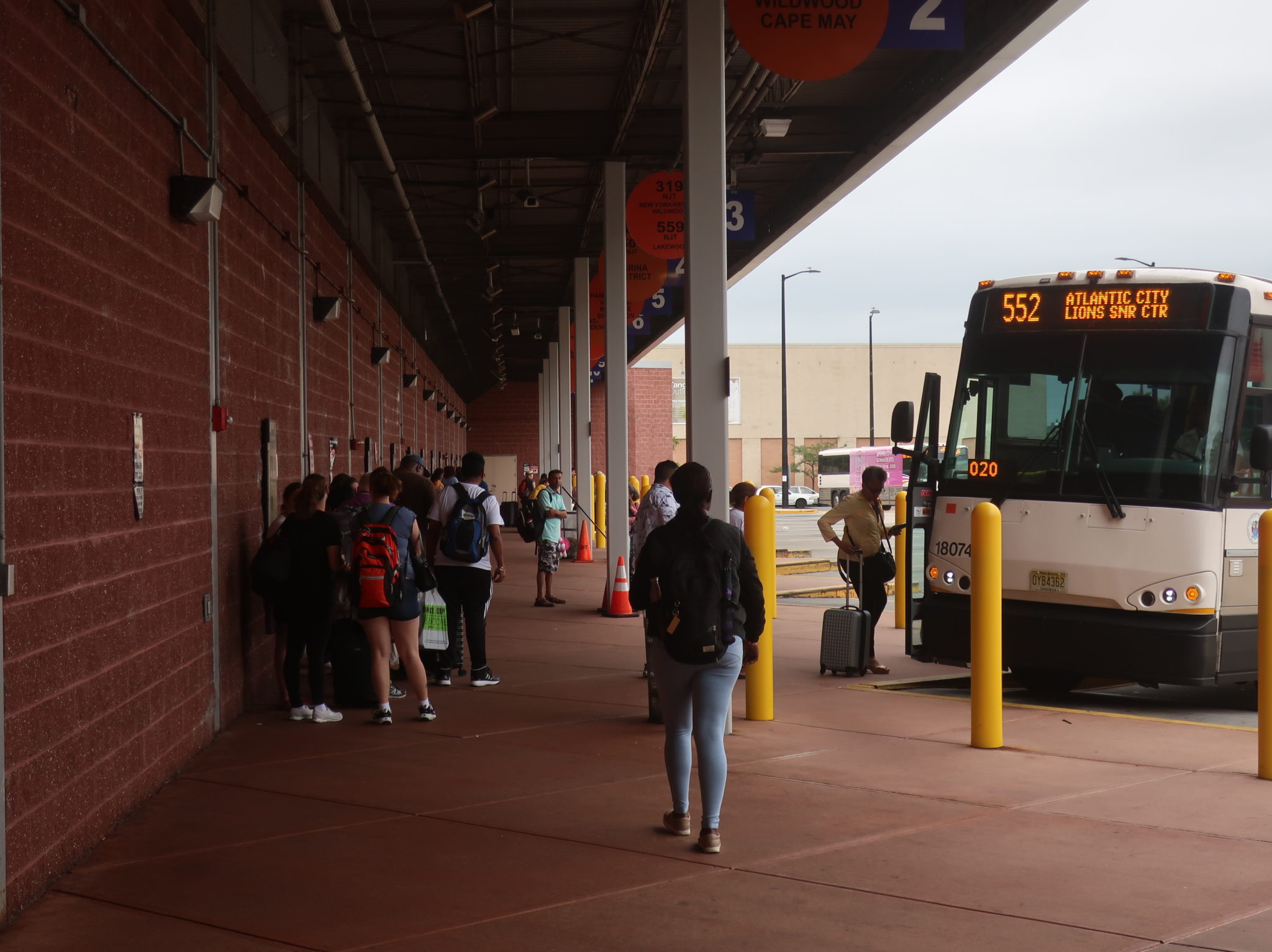
Looking down the berths.
NJT Station: Atlantic City Bus Terminal
Ridership: Couldn’t tell ya. But based on the number of buses that run out of here and how busy the terminal was on a Saturday morning, I would say it gets a lot. Certainly enough to justify the amenities this place has.
Pros: Yeah…it has a lot of amenities! I listed them above and I’m not going to do it again, but any basic needs one would have while waiting for the bus are covered here. Plus, I love how the whole thing is open and staffed 24/7 for both NJT and Greyhound, backing up the overnight services on both of those systems.
Cons: Well…it’s a bus station…so kind of on principle, it ends up feeling dingier than the rail station. There are actual problems here, too, though. For example, the shelters out on Atlantic Ave for the local buses aren’t very well-marked or signed, and they don’t seem substantial enough for the amount of ridership these routes get. The westbound one doesn’t even have a bench in it, for heaven’s sake! Also, in the outdoor boarding area, there’s this odd wiring setup that didn’t seem especially well-thought-out:

There has got to be a better way to set that up.
Nearby and Noteworthy: It’s Atlantic City. The terminal is two blocks from the Boardwalk and its casinos. It’s everything you would ever want.
Final Verdict: 6/10
Assuming you’re getting a Greyhound or one of NJT’s longer-distance routes, you’re all set – the terminal has everything you need. If you’re getting one of NJT’s local buses from here…well, have fun waiting in your potentially benchless shelter. Sorry about that.
Latest SEPTA News: Service Updates
SRTA: FR 2 (North Main)
The 2 turned out to be a dastardly one to ride. Earlier in the day, Sam and I had tried to get it from its Shaw’s terminus to ride it around its long terminus loop, but it had left Shaw’s early. Surprise. I had to grab it later from the Fall River Terminal instead.

A few people waiting to board in Fall River.
We headed out from the terminal and made our way over I-195, eventually coming onto North Main Street. I was surprised – most of Fall River had been underwhelming, but this little strip on North Main was actually kinda charming. There wasn’t even much in the buildings on either side, but there were these nice trees that made it feel a lot more welcoming. I guess that goes to show how far greenery goes in improving the urban landscape.

Well, it wasn’t as leafy on the side streets.
It started to get residential soon, with some dense but nice suburban houses lining the road. There were also a few businesses, particularly around the intersection with President Ave (also the location of a school and a park). On weekdays, there’s an extra deviation here that runs to a place called Commonwealth Landing. It seems like it’s meant to serve Bristol Community College, but there are also some apartments there.

Some houses running up a hill.
The street became a big mix of stuff after that. We went by a cemetery, then there were houses, businesses, and some factories converted to modern uses. Crossing over Route 79, a highway, we got closer to the Taunton River and it was almost all suburban houses for a while. That changed when we pulled into the route’s last stop, Riverview Marketplace – or, as the SRTA calls it in the schedule, “Shaw’s”.

A snaking road.
Except it’s not actually the last stop, it’s just where I got off. When you’re reviewing every bus route on the system in a day, you need to make some cuts, especially if the route screwed you over beforehand! The rest of the 2 consists of a big loop, running clockwise or counterclockwise depending on the time of day. It was the morning in this case, so the bus would have made its way onto Airport Road, running through (and deviating into) an industrial area. It would then turn onto Innovation Way, which is all woods aside from an Amazon facility, which also gets a deviation. Finally, now in Freetown, the bus would have turned back onto Main Street, going past some apartment complexes – one called Four Winds gets a deviation – before returning to Shaw’s.

The back of the bus at Shaw’s.
SRTA Route: FR 2 (North Main)
Ridership: For the SRTA, this route gets great ridership, with about 508 people per day in May 2014. In fact, this is the busiest bus route in Fall River. We’ll see why this fact annoys me once we start talking about the schedule…
Pros: The 2 takes a nice, direct route as far north as Shaw’s. The Commonwealth Landing deviation on weekdays is pretty annoying, but it’s a really pedestrian-unfriendly area, so I understand why they do it. On weekdays, the route runs every half hour from 6 AM to 9 PM – pretty darn good.
Cons: But on Saturdays, it’s every hour! Why? They run half-hourly Saturday service on other routes that get far less ridership than the 2! Also, there’s this twice-daily deviation to “Holmes Apartments” that just complicates the route. I think the residents of Holmes Apartments can stand to walk five minutes to the main route, and then we don’t need this random deviation to just make the route more complicated. Finally, I’m mad that it left Shaw’s early, but at least we had cut it really close so it didn’t feel as cruel as the 9.
Nearby and Noteworthy: This route serves a ton, actually! First, there’s the Children’s Museum of Greater Fall River, which seems like a nice little place for little kids. There’s also the Fall River Fire Museum, which isn’t open to the public “as of yet”, but it’s run by some very dedicated people and they seem to open up for the occasional event. Finally, the loop at the northern end of the route serves part of the Freetown-Fall River State Forest. It looks like it has some beautiful trails with stunning views!
Final Verdict: 6/10
I can’t get over the hourly Saturday service. The busiest route in Fall River only runs every hour on weekends! That’s just crazy to me! Also, this is a prime route for Sunday service if the SRTA ever adds that, which they absolutely should. The Holmes Apartments deviation is also annoying, and in general, this route makes a ton of deviations (particularly on the loop section). That all adds up to a final score of a 6/10 – it’s a good route otherwise!
Latest MBTA News: Service Updates
Atlantic City
Considering that it only gets twelve trains per day (or, at the moment, zero trains per day), five-track Atlantic City Station is surprisingly legit. According to ol’ Wikipedia, it was built in 1989, which makes the size of the station all the more surprising. Service was awful then, too, when Amtrak was running the line, so…yeah, that makes this an interesting one!

A bad picture, but it’s also a bad platform. Tit for tat.
I have very little to say about the station platforms. They’re at a level of barebones that’s just tolerable enough to not affect the overall quality of the station, but on the other hand, they sure aren’t winning any beauty contests, especially with the rotting shelters above. Also, it’s a good thing there are so many tracks here, since this station basically doubles as the AC Line’s yard. If NJT needs to do minor repairs on trains, there are actually facilities here that let them do it.

Inside the main waiting area.
“Seating for Ticketed Customers Only. Two-Hour Time Limit.” Oh, NJT, you never change, do you? Well, folks, you heard it here first: NO SITTING ON THE UNCOMFORTABLE GRATED BENCHES UNLESS YOU HAVE A TICKET. Luckily, you can purchase tickets here at either a few vending machines or the staffed ticket offices, which are apparently open 5:30 AM to 9 PM, seven days a week! That’s impressive. Also of note is the flipboard showing arrivals and departures, although never any origin or destination other than “Philadelphia”.

“ESQUIRES II”.
There are a few other attractions in the rather austere waiting area. One is “ESQUIRES II”, a deli that I can find next to no information about online. I will say that it has very nice seating! The station also has a small parking garage with 75 spaces, and they’re apparently free to ticketed passengers. I don’t know if it doubles as convention center parking or not, but still, I can’t complain about free parking (and no, you don’t get a “jackpot” for landing on it. All that does is make the game even longer than it already is! You know it takes place in Atlantic City, right?).

Another view inside.
But wait, there’s more! Atlantic City also has bathrooms (not particularly bad or good, so not much to say there), an information stand with bus schedules, and a “food court” whose fancy neon sign betrays the fact that it’s really just a few vending machines. Maybe “ESQUIRE II” is considered part of the food court as well.

People streaming out of the station.
I alluded to this a little bit before, but Atlantic City Station is part of the same complex as the city’s convention center. As such, there is a direct doorway between the two, while the exit takes you out to the grand (well, maybe not grand, but big) entrance to the facility. There are a few free jitney routes to all the casinos in the city, but if you’re not getting on those, it’s a 13-minute walk down to the boardwalk. Oh, this entrance also has two giant, clunky bike racks that have probably been here since 1989. That’s right: space for four whole bikes!

The jitney shuttles boarding in the busway.
NJT Station: Atlantic City
Ridership: Interestingly, this is the busiest stop on the Atlantic City Line, with 594 boardings per weekday. That beats out Philadelphia, the second-busiest station, which only gets 489 people per day. It does make sense, though (see my AC Line post for why), and I’ll bet ridership is comprable or even higher on the weekend, especially in the summer.
Pros: This is a very functional terminal. It doesn’t have the grandeur of, say, Philadelphia 30th Street on the other end of the line, but it still has great amenities and services: a big waiting room, ticket offices, and a few options for food. The free jitney shuttles are a fantastic bonus, too, although it has to be said that you’re basically guaranteed to lose money once you leave their casino destinations. In that sense, it would just be cruel to charge for the jitneys.
Cons: Not too much, actually. The platforms look old, as I mentioned, but you’re not gonna be spending a lot of time on them. The location could also be better, but the jitney shuttles do make up for that, and a 13 minute walk to the boardwalk isn’t bad.
Nearby and Noteworthy: If you’re visiting Atlantic City, you’re here for the beach, the casinos, or both. The city offers plenty of each.
Final Verdict: 8/10
Yeah, no real complaints here! It’s too bad that rail service isn’t operating to the station right now, but as it sits there gathering dust (or sand – that tends to accumulate on the tracks), we can at least look at it and say, “Hey. You’re a good station, Atlantic City.” Nice.
Latest SEPTA News: Service Updates
I’ve finally set up a subscribe by email option! Check out the main page if you want to get an email whenever I post.